Thursday, November 13, 2014

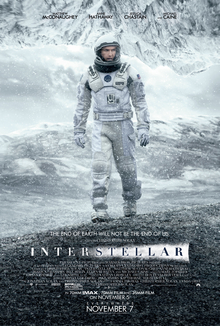
Interstellar... technically Intergalactic?


I can still remember the feeling of awe when I first saw the teaser of Interstellar a year ago. Several scenes in the movie evoked the same feeling in me. This may not be Nolan's best but still is a pretty good movie. 

A lot has been said about the science in Interstellar. Who better than real scientists to give their views on it: Dr. Neil deGrasse Tyson and Phil Plait (who also corrected himself here), and Katie Mack. For a self-proclaimed science enthusiast like me with a particular love for astronomy, this particular aspect seemed intriguing. Although I never really expect Christopher Nolan to make a very science-centric film. His sci-fi films seem more philosophical in nature, that ponder on the human implications of science & technology. Inception never really dealt with the actual process of "dream sharing" but rather its implications. Interstellar is along the same lines. The depiction of wormhole travel and the rendering of the black hole were superb. I loved how they depicted concepts like higher dimensions and relativity, and integrated them thoughtfully into the storyline. The warping of space-time on and near the event horizon was demonstrated visually as well. On a more philosophical note, the way the characters rue the death of scientific temperament & exploration, echoes what many scientists say. From my less-than-expert knowledge, I could immediately note some problems. The communication by Cooper with himself and his daughter through the Tesseract seemed weird. The on-the-fly navigation decisions were also pretty far-fetched. Using gravitational slingshot for travel requires pretty precise calculations, and doing it on a random neutron star or black hole ain't no piece of cake. 

The storyline is very solid. I starts with  a very grim, but very possible, future and works its way to a happy ending. It still would be depressing if we messed up earth so much that we have to risk our lives in this manner than be able to fix it. The visual effects and cinematography are breath-taking and what we have come to expect from Nolan. It is the actors & actresses that are really at the forefront with good performances for all the major characters. This was crucial in a movie that focused a lot on the psychological struggle of an endeavour of this nature.

Honestly, I can brush aside the minor scientific flaws in a movie that overall celebrates science and puts it front & center like few others have done. Like I pointed out before, Nolan is expected to bring the human element to sci-fi. If I have any real complaint about the movie, it is about how this is handled in the movie. If this is a movie about humanity, there should be more of "humanity". Hollywood tends to be US-centric for obvious reasons, but you would expect someone like Nolan to have a more worldly view. Think about the demographics of NASA. In a dying world presented in the movie, won't those smart brains have already left the US for their homes in Europe, Asia? Also, other countries are taking great strides in space exploration. NASA isn't the only player in the game anymore, and it definitely won't be in such a future. Undertaking a mission of this magnitude will require help from several agencies. It was good to see both male & female scientists in the movie working together. There was the token black guy on the crew, but there seemed to be no people on the ground or in the crew from two huge nations that are showing promise for space exploration: India and China. Would have made more sense for this to be a world-wide effort. Although, I did like the nod to Indian engineering acumen (where did that come from?) in the autonomous drone scene.

To conclude, I am glad this is a movie that truly embraces science & exploration. Our universe is awe-inspiring, and there's only a handful of movies that really bring out the majesty of it.

Wednesday, September 24, 2014

Changing Of The Guard

The term "New Atheism" is quite a misnomer, and is regarded by many atheists with disdain. It is generally used to denote the rise of an "in your face" activist movement of unbelief created largely by the likes of Richard Dawkins, Christopher Hitchens, Sam Harris, and Daniel Dennett in the wake of 9/11. To give them credit, they were responsible for bringing a lot of atheists out of the closet. Reading their work and watching their debates was an important catalyzing factor for my transformation from an agnostic "live and let live with religion" kind of person to a more confrontational atheist. I think that I speak for most who share my lack of belief in the supernatural, when I say how annoying I find that a lot of "defenders of religion" make personal slants against these atheist "celebrities" as arguments in their favour, as if all atheists singularly conform to the same set of principles and opinions that they may have.

To be fair, they have garnered a massive following. It's not like there aren't a large number of people who swear by everything that they say. But it is very short-sighted to assume that all atheists think in the same way. In fact, if you take any two atheists, the only thing that you can be certain is common between them is their lack of belief in any god. Personally speaking, there is so much I would disagree with some of these famous atheists. And this difference has become even starker in recent times. Speaking of similarities though, what is immediately noticed when seeing all of these big names is one similarity: they are all middle-aged white men. This predominance is through no fault of their own, it merely reflects the more general tendency of world pop culture. And in the decade since they burst on the scene, it really didn't matter much. They were dealing with issues that cut across all groups within atheism. They were providing the voice of reason against the rise of fundamentalism: from the Islamic terrorists to the Christian right in USA and parts of Europe. Atheism has grown in society ever since science has been consistently advancing our understanding. The spike in growth over the course of the 1st decade of the 21st century, initially at least, seemed to be in the white Western male demographic. Even if that weren't true, the vocal atheist community (online as well) tended to be largely white male. It used to be a boys' club during that period. 

In the last 4-5 years, or so I think, some important changes happened. The demographic has been expanding. Women, people of color (who would otherwise have already been atheists in large numbers) have made their presence felt in the atheist "community" (I will use that term loosely along with "movement." It's just to denote the overall existence of several atheist groups and forums, not a consolidated singular entity). This has happened at the same time the focus within these groups has expanded from merely battling the forces of religious fundamentalism, to providing meaningful reason-based solutions for the world. One would assume that the coincidence of these two events is perfectly timed to advance towards common goals. However, with different demographics come very differing points of view. As I noted before, a lot of these atheist groups and communities were used to being boys' clubs. And let's just say, misogyny is not uncommon. Over the course of time, prominent speakers/bloggers/scientists such as Rebecca Watson, PZ Myers, Ophelia Benson, and Greta Christina have brought out issues of sexism within the atheist community, but the response has been simply disappointing. And a lot of times, some of the atheist "celebrities" have been guilty of misogynistic comments and actions themselves.

A few years ago, in response to Rebecca Watson's vlog speaking about her gender-based experiences at an atheist convention, Richard Dawkins wrote a patronizing "letter" satirizing her "imagined slight" as opposed to the REAL oppression faced by Muslim women in the Arab world. More recently, Michael Shermer has been accused of sexual assault (non-consensual sex with a woman who was under the influence of alcohol while Shermer wasn't), and again, Dawkins has been quick to offer tacit support by questioning the testimony of a drunk woman. Also, there is Sam Harris who responded to the "Why aren't there a lot of women atheists?" with a statement that women tend to be "nurturing" and not immediately attracted to "intense critical thinking," and yes, they also find him "unsexy" (Video here.) When questioned about his responses, his excuses ranged from "it was a joke" to an allusion that the other side was being too politically correct and trying to brush aside what - according to him - are obvious differences between male and female brains. (Actual peer-reviewed research suggests no such purely biological factors exist, and that it has a lot to do with cultural divisions between the sexes.) Dawkins, again, joined in defense of Harris, and they belittled all criticism as "fishing for offense."


Cases like this are not uncommon. These "stalwarts" brand any criticism of them - especially by feminists - as malicious and attention-seeking. Then there is a sort of "coterie" of bloggers and writers who are friendly with famous atheists, that immediately jump to their defense. After them come a set of very annoying YouTube atheist stars that will post half-baked arguments, mostly regurgitating the excuses presented by their champions. After this layer, come the more general rabid fan club members, who are the source of some of the most vile attacks: abuses, rape threats, exposing personal information online, baseless attacks of their looks, etc. That takes care of the misogyny part. Then there is the cultural-racial divide. I haven't seen any particular instances of systemic bias against black people within the atheist community, but a lot of prominent atheists are absent on conversations of race, especially in America. Atheism in India and the rest of Asia seems more or less confined to its own group. Dealing with Islam is more of a grey area, because on the one hand, you have Muslim extremists who frequently hide behind "Islamophobia"/racism to shield themselves from thought-provoking criticism. But at the same time, one can't help but feel that a lot of these prominent atheists display very neo-conservative tendencies when dealing with terrorism, and tend to ignore some very important geo-political factors. Yes, Islamic terrorism does get its inspiration directly from quotations in the Quran and the Hadiths; however, ignoring the effects of Western imperialistic aggression in the Middle-East is over-simplifying the issue. 

As the topics of discourse within the atheist community widen, it seems that we are heading to a turning point of sorts. This extends to the scientific community at large, which also faces several gender/racial problems. Let's make one thing clear:  these problems are in no way unique to the scientific community at all, they are a reflection of our society in general. However, that can't be an excuse. As the promoters of rationalism, it is imperative that we look within and examine criticism of our approach. These atheist speakers have been very successful in debating creationists, religious apologists by bringing out their sound arguments while the other side resorts to denial, defensive posturing, and outright reactionary dismissal. It is curious to see that as we have moved towards a more diverse atheist community, and these old, narrow views have been challenged, we are seeing almost the same reaction from these old men: denial, defensive posturing, and outright reactionary dismissal.

I prefer to keep an optimistic view of things. Collision is inevitable when any avenue visited by a limited demographic opens to a wider audience. Ultimately, progress is the only way to go. In time, I hope these non-white atheists and feminist speakers and bloggers will be able to make an impact and cause some introspection within the atheist community. These people have experiences and ideas that may not have been brought up for discussion previously, and they should be embraced, not instantly and automatically dismissed. Even with the big names, the problem is that they all share a background that has kept them ignorant of the subtle gender and racial issues. But ignorance is not an excuse in this age when it is so easy to obtain different points of view from people and change your outlook accordingly. For people in science, it is a joy to have their mistakes pointed out. It's just sad to see that a group of people who promote reason fail to use it when it comes to reevaluating their own worldview. Instead they aggressively defend their flawed views with loose rationale, and the kind of empty arguments that they would otherwise point out in others. These people can keep denying the problems, but ultimately others will have progressed to a more advanced state of discussion, and they will be left scampering to catch up, not quite unlike the religious people who have to reconcile the morals in their outdated books.


The line it is drawn
The curse it is cast
The slow one now
Will later be fast
As the present now
Will later be past
The order is rapidly fadin’
And the first one now will later be last
For the times they are a-changin’ 
- Bob Dylan

Saturday, September 20, 2014

Musings: An alternate history of the Crusades

The Crusades represent perhaps the worst of the Middle Ages, an already shameful time in human history. Of course, followers of the two religions involved romanticize the Crusades focusing on their respective conquests. The aggregate outcome was that Christendom came out of the Crusades as  the "victor" because it was able to establish the East-West trade route and prospered, while despite defending their lands Muslim factions (except the Turks) faced heavy losses and all but lost their former glory. 

When we talk of religion today, Islam stands out as the largest purveyor of violence, and it is true. The overwhelming majority of violence, atrocities, and acts of terror are carried out by people drawing inspiration from Islam. There is no question about that. However, when the topic comes up for discourse in the West, very often an allusion is made that there is something wrong in particular about Islam or within the Quran. This could not be further from the truth. There are equally, if not more, reprehensible and dangerous passages in the Bible and for all the excuses made about the poetry and inspiring teachings in the Bible, similar things can also be found in the Quran, and they aren't unique or original to either. Then there are arguments about how "Western culture" just happens to be better than "Islamic culture."

Now culture is generally aggregated over time. At this point in history, we do see that a majority of countries with predominantly Muslim populations suffer from many evils. But go back a few decades, and it was "Western culture" to treat people of non-white color as inferior, and women of any color as inferior. A little over a century ago, it was perfectly fine to brand aforementioned "inferior" people as animals and witches, and burn them alive. Yes, Western society has moved on since then, while most of the places in the Arab world are still stuck in those brutal times. The "enlightenment" never happened in the Arab world. The main reason for this is the economic stagnation: while there are rich sheikhs swimming in oil, the majority of the population in the Arab world remains in economic hardship. They were never introduced to democratic rule:  power of the people. The only real distinguishing factor is the different paths that the regions heavily following these two religions took post the Middle ages. During the course of a discussion, I heard the argument from a person that "she was glad that the conclusion of the Crusades happened the way it did, because she would hate to have to wear a burqa." I immediately saw this point as hollow, because if history turned out differently, neither Islam nor Christianity would have turned out the way that they have. So here is an alternate history:

The Ottoman Empire is able to expand upwards from Romania, and maintain its economic stronghold. The influence of the papal order wanes with the lack of economic power. Infighting between the kingdoms resume to gain control of the remaining scraps. The Islamic world continues to revere the ancient works of science and literature. With continuing prosperity, more centers of learning and culture emerge. The "Enlightenment" happens, and thinkers rise that question the absolutist, dangerous teachings within the Quran. They are faced with stigmatization, prison, and even death. Eventually reason wins, and Islam is forced to reexamine its position, given the role that science plays in the continuing progress of the Arab civilization. Meanwhile, the Roman Catholic Church still manages to use religion to stay relevant even between warring factions. Feudalism continues, with no sign of the rise of any "Renaissance" in the destitute poverty that most of the people live in. Witch-burning and bloody wars continue in an endless cycle.

Explorers from Turkey would travel to the Americas. Islamic explorers wage bloody battles in South America against the Incas, expanding the Islamic culture.  However, in North America, small bands of Islamic "rebels," wanting a freer society would end up on the North-Eastern shores. Carrying no inherently indigenous diseases, rather than wiping out the local population, they would be forced to co-exist at the minimum level. Attempts at conquest by Muslim pilgrims would not be as successful, and ultimately the local Americans and Muslims would lay the foundations towards a pluralistic society.

Back in the Middle-East, at the turn of the 19th century, science slowly overcomes religion. There are groundbreaking discoveries in technology and understanding of nature, facilitated by works that were never lost after the Crusades. These are further contributed by the existence of a direct trade channel with the East. Even as the Mughals fall to the Marathas in India, these routes continue. The rest of the Islamic world comes to a compromise with the Marathas regarding their sovereignty over the Indian lands*. Revival of ancient Indian literature, coupled with the Indian renaissance to rid society of superstitious evils leads to a strong, united India with a sense of nationalism even before the 20th century dawns. Coupled with the influence of the new Indian nation and similar cultures in the Far East, thinkers in the Arab nations make a push for democracy. Islam is influenced by this progressive culture to become more open, making followers brush aside the violent aspects of the Hadiths.

In Europe, civilization still lingers in the Dark Ages. Women and ethnic Jews are blamed for the overwhelming poverty and strife. These groups are still regularly tortured and killed. The Catholic Church continues to exert its influence. It keeps out the influence of the progressive nations of Asia and the Middle East, demonizing them and exhorting people to reject their "corrupt" ideas. These infidels are also to blame for draining Europe of its wealth. No World Wars happen, instead there are several smaller conflicts: between China and Japan, between certain Arab nations over political ambitions, and between Muslim colonist and local Americas over sovereignty in the Americas. No longer at the mercy of violent battles between outside colonizers, the African nations slowly rise.** Formerly influenced by Islam, yet retaining their ancient sense of African heritage, they slowly move away from organized religion and return to their richer African culture. Leaders emerge that use economic stimulus and education to stop tribal wars, thus uniting them under their respective national flags. They willingly immigrate to newer lands of opportunity in the Americas (and yes, African American culture still thrives). And the burqa would be an exhibit in a museum or a uniform for the religiously devout Muslim women clerics in madrasas.

* Trade routes between India and the Arab world existed for centuries. Once the Mughals fell, Arabs would see little reason to risk a beneficial economic partnership over any ambitious plans to start a battle against a well-equipped and invigorated Maratha Empire.

** A big reason for the perpetual poverty in Africa is that they were constantly stuck in the tug of war between Europeans and the Arabs. In a world where Europe falls, and it is the neighbouring Arab world that undergoes an "Enlightenment." Africa gets a chance to breathe and escape the clutches of colonialism on its own.

Friday, December 27, 2013

Ignorance is bliss... sometimes?

That old adage came to mind when I was deep in thought a few days ago. It is the holiday season, and most of the civilized world celebrates Christmas. I did not have to come to the US to know of this festival. Its celebrate with as much, if not more enthusiasm back in India, and most people there aren't the least interested in Christianity or Christ (So there, fuck you Republicans).

I personally never cared too much for festivities. I treated Christmas like I treat any other occasion back then, just a day to enjoy while the religious do their thing. After coming to the US and noticing the fervent religiosity made me interested in the subject of theism. As noted in my previous posts, up to a few years ago, I never really considered the idea of God as anything but a harmless human construct used as a source of inspiration by most. But the intensity of belief in the majority of the population of this so-called most developed country in the world made me examine this construct more. One of the aspects of this is this so-called "War on Christmas". Now I tend to single out the Republicans on most religious issues, at the risk of being accused of generalization. But it is no secret that the religious extremists align themselves with that political party, so the line that distinguishes them is pretty blurry. Anyway, they go through great pains this time of the year to put "Christ back in Christmas". That brought me to the most obvious counter-argument: was there ever a Christ in Christmas? Firstly, the subject in this case, is mostly likely completely fictional or just partially based on one or more people that existed back in that period. Also, the birth of that fictional character as described in the bible does not even fall in this season, let alone the date. So why this date? The answer to this question brought me to the more sinister aspects. This date, December 25th, falls around the time most of the ancient civilizations around the Mediterranean and the Middle East used to celebrate the Winter Solstice. Even the idea of making your favorite deity's birthday happen to fall on this day is not an original. Horus, Mithra all share the same fictional birthday & predate Christianity by over a millennium. So far, its merely plagiarism. Now, moving on to the "traditions" of Christmas, they're original right? Well no, nothing is original. The Christmas tree in reality is the Saturnalia tree, celebrating the ancient festival of Saturnalia, a pagan tradition. The mistletoe, the wreaths and the holly are all Wiccan traditions. The concept of an anonymous gift-giver comes from Thor and Odin. Christmas carols? The stories are plagiarized from old legends. The idea of carols comes from the Scandinavian God Yule.

Now, these things I wrote are nothing new. I'm sure a lot of my friends know these things as I found out over the last few years. I just thought of it this way: these traditions are actually ancient traditions that were initially criminalized by Christianity. Alexandria was burned down to wipe out the existence of  paganism. Witch-hunting was responsible for the extermination of Druids and Wiccans. One could be executed for having a decorated tree at home during the middle ages. This oh-so-favorite tradition only became accepted in the 16th century. All this makes me think of Christmas celebrations as a cruel joke. They wiped out all the rich ancient philosophies, and replaced it with their dogmatic monotheism. Then, they assimilated the traditions that came from those philosophies to make it look like they belong to Christianity. Now, the argument can be made that this is not what most Christians see it as. But the truth remains. I feel this is propagating the same cruel joke. Its a lot like Thanksgiving, what people celebrate as a moment of gratitude & good nature, is actually the harbinger for the annihilation of an entire race. Another cruel joke to celebrate it as such, isn't it?

Given my disinterest in festivities and my disdain for Abrahamic religions, it doesn't change much for me. But a lot like many atheists do around this time (perhaps not with the same purpose) I will join along to bring out the true roots of these fake traditions. I guess this is like a "War on Christmas", to help remember to old philosophies. I feel a certain affinity towards them, since I come from a culture which dates back to the same time. Though Hinduism has been corrupted from within and through the effect of the invasion of forces affiliated with the Abrahamic religions, it still survives. It is a painful thought to place it in the shoes of those other more-or-less concurrent philosophies. This new realization has changed my feelings towards the celebrations at this time. Initially, it seemed the phrase "Ignorance is bliss" rang true. But I guess I'm happier knowing these things than be in so-called blissful ignorance.

Wednesday, July 31, 2013

In A World Like This


I have been listening to the whole album repeatedly, and letting it sink in. So here goes, my review for In A World Like This:

Overall, its a very solid album. They incorporated different influences pretty well, and it seems like they made a conscious effort to have a range of songs that will appeal to different tastes in the fanbase. 


In A World Like This - Great choice for the first single. Not the best song in the album, but it acts like a bridge with the old-style hooks & harmonies & does well to represent the whole album. I love the build-up in the chorus, that continues into the soaring vocals towards the end. Lyrics are typical Max Martin: vague but on the whole give an upbeat feel.

Permanent Stain - My guilty pleasure on the album. Its a dance-pop song, with generally bland lyrics, but some lines (like the pre-chorus) stand out. The chorus is especially catchy, it has this anthemic feel to it, that I enjoy singing along to.

Breathe - One of my favourites off the album. Starts with some lovely keys, and the bass-heavy sound gives a perfect somber mood along with Kevin & AJ's haunting vocals. Brian pitches in very well with his adlibs. The lyrics are fantastic too, I know AJ has been credited with conceptualising the song, but it has Brian's 'literal' style all over it.

Madeleine - This song is beautiful: Great lyrics, a pretty acoustic guitar driven sound, and Nick's amazing vocals. AJ follows through really well. I like that they didn't really build up past the bridge, this song deserves a mellow sound throughout. Flows like a nice pep-talk to a depressed person

Show 'Em What You're Made Of - Another one of my favourites. When you listen to the lyrics, it immediately hits you that they have come from a deep, personal place. Again, the AJ-Kevin team is perfect to carry the mood of this song. The chorus is simply arranged but effective, with the Boys beautiful harmonies. I like the arrangement after the bridge, where the chorus goes with a drums-only part. They've used it more than once on this album. 

Make Believe - This should count as a unique song. It has a haunting, other-worldly feel to it, right from the semi-symphonic beginning to the synth keys at the end. For me, the lyrics paint the picture of two deep-in-love travelers, running away from everyone else, imagining a perfect world for themselves. The use of synth & post-processing on the vocals works just perfect to create the right feel for the song

Try - I’m not the biggest R&B fan, but I appreciate a great R&B/soul song when I hear it, especially in a world like this, when all kinds of crap gets passed off as R&B. This song has a beautiful arrangement, along with good uplifting lyrics. And then there one more little thing: AJ SOUNDS ABSOLUTELY INCREDIBLE

Trust Me - Another favourite, and definitely a unique song. An acoustic song with breezy, easy-going lyrics, & some lovely instrumentation. My favourite parts are Kevin’s Dean Martin/Sinatra inspired verses & the sing-along climax with awesome raw vocals

Love Somebody - The only song on the album I don’t fancy much. Bland lyrics, typical dance-pop sound. I just like the bass+ distorted guitar riff, breathes some life into this song.

One Phone Call - Another AC leaning song, with lovely harmonies. Interesting lyrics, using prison time as a metaphor for a broken relationship. That along with the sweet synth drum beats & muffled phone-call like vocals give a nice twist to the song, which is otherwise familiar BSB territory.

Feels Like Home - If someone had asked me earlier this year, I would’ve cringed at the thought of another fan song. But I absolutely LOVE this one, its among my favourites on the album. The lyrics hit home for me, the words of a traveler. Great beats, this really is my jam.

Soldier - I wasn’t interested in this one from the initial preview. But AJ’s vocals got me interested, and overall it’s a very solid song. Howie has some surprisingly good vocals at the bridge, and there’s another use of the drums-only chorus reprise.

Bonus songs - Really liked Hot Hot Hot & Take Care. Both have extremely unique sounds, and the Boys adapt themselves really well, show off their versatility. HHH especially, its brash, with no pretense of any serious lyrics: it does perfectly what PDA failed miserably at. Light On, IYA are good dance-pop numbers, but interchangeable with any of the other couple of songs that are already on the album.

I was initially very skeptical of the Morgan-Prophet team, but they delivered. Their general specialty seems to be dance-pop numbers, but they did a fantastic job with Show ‘Em, and OPC is really good too. Dan Muckala has once again done some great work for the Boys with Make Believe & FLH. Max Martin did his job well to give them a lead single. I hope they work with him again in the future, they have made some magic together in the past. Not sure what I think about Justin Trugman, with just Love Somebody to judge him by. And lastly, Martin Terefe has been phenomenal. I loved how the chemistry worked out with him and the Boys. I sincerely hope they work with him again, I wouldn’t mind him being the sole album producer next time around, and they work around some central theme, even make a concept album together.


To conclude, this album won’t be replacing Never Gone (2005) on my list. But with this being the Boys’ first venture on their own, it’s a very encouraging effort and definitely goes close to the top of my list. The way they have been involved in the songwriting process and experimenting with different sounds has me very optimistic about the future.
(Photoshoot pictures courtesy backstreetboys.com, albumartist.co.uk, tylershields.com)

Thursday, June 20, 2013

Religion without gods

If you have read my blog from the beginning, one of the things you might have noticed is my evolution from more of an agnostic (or deist rationalist?) to an atheist. I guess even then I made a case for an existence out of necessity of an imaginary deity. In any case, during my time in Buffalo made some good friends who happen to be atheists (closet or otherwise). Being heavily interested in science, especially astronomy, my interest in people like Carl Sagan, Neil deGrasse Tyson led me to the more "in your face" Richard Dawkins, Lawrence Krauss, Sam Harris & Christopher Hitchens.

Now my atheist friends here also happen to be Indian, so I grew curious about the situation back home & started observing social networking groups dedicated to Indian atheists. I found some peculiar differences between those groups and me & my friends. Now I don't presume that my friends & I will agree on every single idea I present. But there are some basic things that I found to be in stark contrast with these Indian groups.

I'll first broaden the topic from atheism to rational thinking in general. I have found that in pursuit of a rational dialogue, these people keep a very deep focus on completely rejecting anything associated to ancient Indian religion. I tend to feel they try to mimic Western atheists & their treatment of Abrahamic religions, and forget the differences between them & Indian religions. Hinduism has been borne out of the cultural traditions of ancient Vedic times. It is a result of different philosophies, that have changed over time, in good ways & bad, and it has no central doctrine. Another important difference, in Vedic times, schools of thoughts actually dabbled with the idea of atheism: a universe without the need of a conscious creator. Coming closer to modern times, Savarkar, the proponent of Hindutva, was most probably an atheist, who based his philosophy on combining ancient Hindu teachings with rationalism. Needless to say, Hinduism has become closely intertwined with Indian culture I find it rather hard & also unnecessary to focus on completely breaking those ties. For progress, it is important not to cling to the past, but also be aware of it. India has had a rich & long history, and our Hindu philosophy forms a very important part of this: the literature, scientific/educational achievements, architecture, socio-political philosophies. In an interview, Richard Dawkins voiced his absolute support to preserving Anglical traditions because they form an integral part of English society. And this is Christianity, a Middle-Eastern cult imported as an organized religion into Europe. And... this is Richard Dawkins!

By all means, they should continue to oppose all unscientific wasteful & dangerous practices carried out in the name of religion & tradition. But an Indian atheist shouldn't become a clone of a western atheist. A western atheist would most probably lack the context to get into a dialogue with Indian masses, and would be considered as trying to "impose their western ideals". This is where an Indian atheist has a better chance of forming a dialogue, going back to ancient Indian traditions of critical thinking, showing them that they are stuck in a convoluted, reactionary form of Hinduism. This isn't merely a rouse. Its only natural if you have a strong platform of critical thinking in your own culture, you use it to help the masses absorb new ideas from all over the world. Rather than trying to demolish everything you have & trying to mimic something else.

I suppose this extends to all ancient Eastern philosophies. Its an interesting pattern I noticed looking at other parts of the world with ancient civilizations that were lost. Watching Africa, the cradle of humanity itself, where Africans kill their fellow Africans in the name of Christianity & Islam, the religions responsible for destroying their old heritage. Or watching large populations of South Americans kneel before the Catholic Church, the very same one that authorized their slaughter less than five centuries ago. Or the heavily religious black community in the USA, with the same religions that aided their former enslavement.

Of course, this is atheism & rational thinking we are talking about, so comparisons with such extreme cases are out of place. The only point to take away is that a complete abandonment of your self-identity is never a good thing.

Sunday, January 6, 2013

Of knowledge & arrogance

I want to start off with small anecdotes about two revolutionary thinkers I admire: Johannes Kepler & Charles Darwin.

My interest in the universe goes back to when I was 8-9 years old, and I laid my hands on "The Universe" from the Childcraft series.I first came across the notions of Ptolemy of a geocentric universe. I disliked him in those days, thinking what a fool he was. That has changed since I grew up, and realized he was merely trying to make sense of what he saw, and did it better than anyone else in his time. Those notions, as I saw on the next page in the book, were challenged by Nicolaus Copernicus over a millennium later, at the risk of being put to death by the church who preferred to waddle in their ignorance. He was a hero who started a  revolution that spawned generations of scientific thinkers who challenged the dogma of the authorities & slowly took the world out of the dark ages. One of those thinkers was Johannes Kepler, who furthered Copernicus' heliocentric model. I only learnt of Kepler's discovery of planetary motion in the book, but about the background much later from Carl Sagan's Cosmos. Kepler was a deeply religious man, and very fond of mathematics. His idea of the Creator was that of the ultimate mathematician, who had designed the universe with grand equations which ruled all the objects in the universe. One of his earlier works about planetary motion involved the concept of concentric polyhedrons that governed the motion of the earth & the other 5 known planets at that time. He passionately persisted on this theory for several years. The idea was in sync with his belief in the celestial mathematician and he believed with all his heart to be true. But to a scientist, mere belief isn't satisfactory. He worked for years to fit this model with observations & calculations of motion, but to no avail. He struggled with it for years until at the crossroads, he decided to let go & pursue new possibilities. And after this he discovered that the sun was not the sole center for a planet's orbit, but was one of two focii, as the planetary orbits were elliptical. And this discovery became a monumental leap in the understanding of planetary motion.

When Charles Darwin set out on the HMS Beagle he was definitely not being guided by the devil, as some people would like to believe. His original intentions were to study how God had created & arranged different species all over the world. His first study led him to the discovery of natural selection, and ultimately to the origin of species. He had never intended to oppose the idea of God, but his research just led him to the conclusion that all species arose from a single common ancestor, and the stories of creation that were being propagated through some religions were just untrue. He struggled with the magnitude of this discovery as any person would, before finally publishing "On the Origin of Species". Along with staunch opposition from self-proclaimed religious authorities who know next to nothing about reality, Darwin's magnificent work wasn't clearly understood until the 1960's, with the discovery of a large array of fossils & advances in genetics helping to prove that the theory of evolution is inescapable fact.

Now, in popular media the stereotype of scientist is always that of an arrogant person who scoffs at common people. This image persists in the public as well. The idea of painting any group like that seems absurd, since arrogance is a personal emotion. Sure, there would be some scientists that are arrogant, but its just as likely as any kind of person in general. If it can be applied to any group, I would personally nominate hardened followers of any religion. Some would argue that those who have faith & bow down before a God cannot be arrogant. But it is faith that makes them arrogant: to believe that only only their God out of the hundreds created by man is true, that this God has chosen a specific group of people & they are part of it, that their beliefs have to be given even the slightest of respect without a shred of evidence. Now that is arrogance. Like I said before, there will be people in science who act arrogant. But the greatest scientists are always those who accept their failures & are willing to change their most passionate beliefs in the face of concrete contradicting evidence. 

Friday, October 26, 2012

Template for a religion

A young man brought up in difficult conditions seeks to change the society he sees around him. He is supposedly a revolutionary who rebels against the injustice being practiced in society around that time. His acts earn him a dedicated group of followers. Soon, the powers that be are threatened by his growing influence and supposedly torture & kill him brutally. After his death, a lot of people begin to associate themselves with him to gain people's trust. They see how mesmerized the people are by the dead man, and soon make up stories about his divinity. Casting him as a Messiah, they prepare texts making them out as words of their Messiah straight from God. In them, they insert commands & rituals to fit their own personal needs. This group grows & the powers that be now seek to reconcile with the agitated people. Seeing that the majority has now turned over, they switch their allegiance from the old religion to this new one. And after handsomely rewarding the "leaders" of this new religion, they create the official version of the "word of God", taking lessons from the leaders, and tailoring it to their own selfish needs. The leaders & their successors in turn are granted unquestionable moral authority for centuries to come. Together the powers that be, & their moral "advisors" enjoy a  continuing reign where they feed off the ignorance & subservience of their people. This template is followed by others, and twisted & concocted even more. These other Messiahs don't  even need to be good men. He can be a charlatan or a murderer, yet as long as he commands influence over a group and says the magic words "I heard the voice of God", he becomes a Messiah & a new religion is born.   Also notice how its always a he never a she. The words in their "Holy books" are used to command them to fight & kill for their respective religions. The powers that be sit back & plan out new regions to conquer with their brain-washed armies. Some of the religions are then forced to give up their violent ways. So they try silent brain-washing to influence people to change the laws of the land, so they can continue to rule. 

And there you have it, a template for creating a religion, that continues to be used to this day. 

If religions stopped fighting over who is right, and think over where they have all gone wrong, the world would be a much better place

Saturday, August 25, 2012

Mars & Beyond

[Curiosity hi-res photo of the Gale Crater: Image courtesy: NASA]

Let me start off by saying how much I'm loving the attention the latest Mars mission is getting. Ever since NASA released it 7 minutes of terror video in the build up to final weeks of Curiosity's landing, the news & social media has been buzzing about it.

And now that Curiosity is on the ground on Mars, the possibilities seem endless. If the space enthusiasts among you recall, it is very much like the first few weeks of Spirit & Opportunity. We are getting newer photographs of the surface of another world: so much like ours, and yet so different. So what is different about the Curiosity mission then? First off, the rover is much bigger & has a lot more gadgets on-board. Its a mobile Science Lab, that will analyze rocks on Mars. There were limitations to what the previous rovers could do, and Curiosity will now fill the gaps. It has landed within the Gale crater, and will continue to drive to its rim, using its powerful lasers to cut off sedimentary rock from multiple layers along the sides of the mountain. Scientists hope to find glimpses of the history of Mars in these layers, much like we do on Earth. Curiosity is on its own for the most part, roaming the lifeless planet, picking up rocks & studying them, as long as its solar-powered batteries hold up.

NASA has already gone ahead and decided on its next mission. They will be sending another space-craft to Mars in 2016, aimed at drilling through the surface to learn about its core. It won a vote over two other missions: one, to explore the methane lakes on Titan, and another to land on a comet. Personally, I feel disappointed that NASA is down to picking & choosing missions. I'm not exactly sure its a direct result of budget cuts, or just a logistical problem of doing several missions simultaneously. I do suspect the budget cuts have a large part to play in this. I would personally be thrilled at the prospect of an actual mission to Titan in the future. Along with Europa, it is one of the two potential places to look for the possibility of life within our solar system.

Is there any help for NASA? Private companies have come forward for low orbit launches, but long-term missions need government help. Other countries like India & China are taking positive steps for this. India is preparing for the Chandrayaan-2 mission that will involve landing a rover. China is planning an orbital mission to Mars some time in the next decade. Its clear that NASA continues to remain the one best equipped to expand the frontier of space travel. Here's hoping the powers that be can take notice of the interest the Curiosity mission is generating and spare a penny for NASA.

Monday, July 9, 2012

The Requiem


We swim against the rising waves
And crash against the shore
The body bends until it breaks
The early morning sings no more
So rest your head, it’s time to sleep
And dream of what’s in store
The body bends until it breaks
Then sings again no more
’Cause time has torn the flesh away
The early morning sings no more

- Final verse from 'Until It Breaks' by Linkin Park from the album Living Things

Sunday, June 10, 2012

Big things have small beginnings


After two decades, Ridley Scott returned to the genre he shaped with 'Prometheus'. Being a big fan of the Alien films, and of the director himself (Gladiator, Black Hawk Down) I was naturally delighted to watch this movie. 

At the onset, its a given that you would appreciate this movie more if you are familiar with the Alien franchise. There are several subtle & blatant references to the mythology, and the director has made it clear that it takes place in the same universe but is not a direct prequel. The visual effects were mind-blowing, and it is recommended for IMAX 3D. It is not exactly like the Alien films. More of an adventure-cum-horror film, rather than a pure horror film. The script is pretty good, although the film lacks those 'moments' for the general audience that you expect from a film of this monumental scale. I did had a couple of awe-inspiring myself, seeing the panoramic view of the universe in a few shots. A particularly breath-taking one was seeing the shots of supposedly the early earth: cooled down, with land, water, yet a lonely, desolate place. The film has an amazing, haunting soundtrack as well. Scott has attempted to create a new mythology with this film, & its clear he would like to make at least one sequel. The film raises quite a few questions, and leaves most of them unanswered, or more like open-ended questions, since the sequel is not guaranteed.

Its these questions that I immediately started to dwell upon, as I began to absorb the experience of the movie. At the beginning, through the explorer & 'believer' Elizabeth Shaw, we are given hints about a supposedly contradictory idea to the facts of evolution that we know. An idea of beings akin to a "God" that engineered us, and therefore referred to as 'Engineers'. Even Scott in an interview, to my disappointment showed more than a hint of ignorance when he said "Both NASA & the Vatican agree that we could not have come this far without a little help". Yet, the open-ended conclusion of the movie gives you the feeling the director has left it to the audience to connect the dots, in terms of their own interpretation, & also their beliefs, or the lack of them. For me, the opening shows the inherent self-centered tendency of humans to believe that "its all about us". The opening sequence actually shows an earth at its very primitive stage, when there was no life here. When the 'Engineer' drinks from the vial he is carrying, he begins to disintegrate, right down to his DNA. If we come back to the real world for a bit, life itself began out of the primordial soup that would form when a planet cools down. I say planet, since scientists think the life we know of, may not necessarily have been formed this way on Earth. Maybe Mars, maybe some distant planet, and just piggybacked here accidentally on a meteor as an aftermath of cosmic collisions between planets & comets. The film does a cinematic take on this to move it a step further. So the Engineer does not directly create humans, he sows the seed of life, which to this point has come up with the humans as we are today. I interpret it as the director first giving us a picture of the idea of 'Creation' as a lot of religions understand it, and then smashing it. As the movie goes further, we find that the 'Engineers' are not the benevolent, serene beings that we pictured as our Creator, but just an alien race of life-forms that has developed the ability to create life in the laboratory, and doing this for no particular reason except "because they could". And from the look of the meeting that takes place between the humans & the lone surviving Engineer at the "manufacturing facility" that is the moon of the system that the ship Prometheus lands on, our makers are pretty disappointed at the results of their experiment. And to smash our misplaced sense of self-importance further, this is, by no means the only experiment. As the movie unfolds, we see a myriad of life-forms being created out of the engineered primordial organic soup, and its 'interactions' with the life-forms it encounters. The Engineers themselves are hardly Gods, being overwhelmed by their own creations and the manufacturing facility itself has been almost destroyed even before the humans arrive. And our creators have also decided to dismantle their Earth experiment, by carrying the vases of the same disintegrating fluid that created us, possibly in the hopes of better results.

The character of Elizabeth Shaw does have an adequately conflicting personality, despite a rather unconvincing performance by Noomi Rapace. For me, Michael Fassbender as the android David stole the show. Charlize Theron wasn't as noticeable as Meredith Vickers. And I was disappointed by the small part Guy Pearce had as Peter Weyland. But there is a very special guest appearance right at the end of the movie, after one of the life-forms created after the Shaw is impregnated by her 'infected' lover. The foetus is expelled surgically by Shaw, yet survives and grows in a matter of hours. The surviving Engineer runs into its tentacles and it grasps him, and its revealed to be much like a giant "face-hugger" that people who have watched Alien would be familiar with. Then, as expected the Engineer's stomach begins to burst open, and out comes another vaguely anthropomorphic figure. As it stands up and you are given a full view of its structure, it is clearly a predecessor/early ancestor of the legendary Xenomorph, or as it is called "the Alien". 

I do hope Scott comes up with a sequel and expands further on this mythology. Hopefully, it will follow a more scientific than a mystic/religious path, but I am not averse to a vivid imagination that incorporates elements of the very imaginative mythologies of Indian & other ancient civilizations, such as the one present in the legendary Star Wars mythology. It should be something that broadens, not stifles the imagination of the audience. I haven't really checked but I don't think Prometheus will challenge the might of the "Avengers" at the box-office, or the expected one of "The Dark Knight Rises". But it has certainly opened up the prospects of a very interesting franchise. As David says in a scene from the film "Big things have small beginnings".

Saturday, February 4, 2012

Nick Carter - Live in NYC

It is surprising even to myself that despite being a music lover, I have never been to a live concert. The major reason has been my aversion to crowded places. However, it has been one of the important things on my checklist recently. I missed out on the Dream Theater concert in San Francisco while I was there. I'm still hoping they do a second US leg of their ADTOE tour. So, when Nick Carter decided to have a concert at Irving Plaza in NYC, I immediately got my tickets for the show.
This was a pretty modest-sized hall, and the concert was more like a House of Blues show. The doors were gonna open at 8pm, so I came there by 7.30, and the line had already snaked around the block by then. I have to admit I stood out from the beginning, being one of the few guys among an ocean of girls. It was past 9 pm before the opening act came out, some female pop singer named Guinevere. She looked hot in her flashy outfit, but was mostly lip-syncing, and I had to bear through her mini-setlist of around 4 songs. Then, the curtains came down while Nick's band set up their equipment. Finally, around 9.45 the curtain (more like a projector screen) went up and the crowd let out a huge roar. To the background of radio transmission excerpts from space flights, and some epic entrance music, the band members came out wearing white space-suits and settled in their places. Then Nick came, out with a full space-suit and helmet, standing in the center, back to the crowd, a band member equipping him with his guitar. As the lights came down, he turned to the audience as the screams grew louder, approached the mic and launched into "I'm Taking Off", the title track off his new album, followed by "Blow Your Mind" from his 2002 debut album Now Or Never, and "Not The Other Guy" again off the new one. He then paused to thank everyone for their support, and exhorted the crowd to be his 'aliens' he is visiting, and then sang "I Got You" from NON, which is my favorite solo song of his. I was naturally singing along, eliciting a few curious stares from the girls around me. Nick later did an awesome mix of "The Great Divide" (another fave) with U2's "With Or Without You". Later in the show Nick picked up the guitar again to do to BSB's "Larger Than Life", with his guitarist nailing the solo part perfectly. His drummer was exceptional as well, Nick mentioned he was with him during his first solo album tour. After the second break, Nick came out alone with an acoustic guitar in hand, dedicating his next song to his sister Leslie Carter, who had passed away just two days before with the words "I've not done his before and never thought I'd ever have to. I wanna dedicate this song to my sister". And he did an acoustic rendition of "Falling Down", and choking towards the end, he rushed to the corner of the stage as soon as he finished, to compose himself. That was a pretty intense moment, and the crowd went quiet for a while before starting a "We Love You" chant to cheer him back on to the stage. Nick came back, taking the mic and saying "Lets celebrate her life Goddammit" and went on to perform the last two songs of the show, the eternal BSB hit "I Want It That Way" and his new single "Burning Up", pumping up the crowd and ending the show on a high note.
To sum up, it was an incredible night. Nick was amazing throughout, and though I already know this from the countless live videos I have seen, I could witness in person that he (and also the other Boys) know how to deliver an amazing show, most importantly with amazing vocals.  And I am looking forward to checking off the rest from my list: Backstreet Boys, Metallica & Dream Theater. Sadly, I would never be able to see the Eagles live.  (Picture courtesy: user fsquared87 on Photobucket)

Monday, January 16, 2012

Who are we saving again?

Some of those ads about nature conservation & reducing pollution are certainly very powerful and emotive. But  in recent years, I have come to see a fundamental flaw that prevents them from having any lasting effect on the psyche of people and make them actually do something. A lot of it has stemmed from all I have learnt about the universe since childhood. But what made me think about it more is the philosophy of Ian Malcolm, a character in Michael Crichton's Jurassic Park series. 

We as humans are often fooled by this illusion of grandeur. Some religions preach about the 'special' place of humans in the scheme of things. It comes from the technological advances as well. While the scientists responsible for them generally have a sense of nobility towards the cosmic forces, the end-users of the technology are overwhelmed with a misplaced sense of invincibility. So, when they see a slogan like "Save the Earth", they will inevitably have a laid-back attitude towards it. It makes it seem like an act of philanthropy, which it most certainly isn't. Moreover, if you think about it a little more, that slogan itself is false. Yes, we are disturbing the delicate balance in various ecological systems throughout our world. We have caused extinctions of several species, and are still pushing more species towards it. But lets look at the bigger picture. A few hundred years down the line (or probably much, much sooner), we may have caused enough irreparable damage to cause a whole bunch of species, including ourselves, to be extinct. Now step back to see this from the Earth's point of view. For the Earth, this will be just the latest addition to the many extinctions that have occurred in its near 4 billion year history. It is quite likely that in the next few millennia at the most, a fresh batch of ecological systems will replace the ones that were wiped away. As a species, we have achieved a lot, and made phenomenal progress since the first Homo Sapiens appeared 200,000 years ago. If we stretch it to our entire genus, it will make us about 3 million years old. But, take for example dinosaurs, who were the dominant genus for well over 100 million years, and how easily they were wiped out and forgotten. So its funny that people think its the Earth we are saving from being doomed, and that if the worst happens, somewhere in the future, we will fly off to another habitable planet in a ship. Going by how scientists struggle for funding to even look at habitable planets elsewhere in the Universe, I wonder if anyone would have the foresight soon enough for us to develop a reasonable plan of action for that. So, if its a gradual extinction from the extremities of shifting weather conditions, or an instantaneous wipe-out from a nuclear holocaust, its our species that is at stake. The Earth and most certainly the Universe will go on without as much as a hiccup. 

So boys & girls, next time you put that can of soda in the recycle bin, remember, you're not saving the Earth, you're saving your own sorry ass!

Saturday, December 3, 2011

Imagine

John Lennon's masterpiece has been covered by many artists. But along with his original, I found two versions perfect to fit together, to create a trilogy.

A silent hope:


A passionate cry:


A gloomy acceptance:

Monday, October 31, 2011

Backstreet Solos

Wanted to compile this for a while now. Here are my picks from the solo efforts by the Backstreet Boys

AJ McLean


Brian Littrell


Howie D


Kevin Richardson


Nick Carter


Friday, October 14, 2011

Prayer to Self


Keep inside me, the desire
To jump and reach the sky
And stars along my way
And help to give me strength
To make the most of each day
I am ready, help me be all I can be
I am ready, help guide me, and keep me free

(Based on the Twelve-Step Suite by Mike Portnoy)

Monday, October 3, 2011

Siberia

I am a huge fan of the Backstreet Boys. Back in 2005, they released their 'comeback' album Never Gone after an absence of almost five years. I had very high expectations from them, and they didn't disappoint. Right from the first single: the power ballad 'Incomplete', and the almost alternate-rock 'Climbing The Walls' to mid-tempo pop/rock numbers like 'I Still', 'Just Want You to Know' and slower tracks like 'Never Gone', 'Safest Place To Hide', I loved every single track, and listen to the whole album from top to bottom to this very day. The album was their experiment with an organic, live instruments only sound.

But one song in particular is most special to me, and is actually my favorite song of theirs of all time. Named 'Siberia', it is the darkest song they have ever done. Its a song about heart-break, but rather than the cliched pleading tone of similar songs, it echoes a sentiment of acceptance of the inevitable end. The lyrics in the bridge even have an accusatory tone to them, something very un-Backstreet. The song is written & produced by Max Martin. The music itself is also equally haunting and makes up the somber mood of the song.

(Credit: YouTube User BackstreetBoysVault)

Saturday, October 1, 2011

Invictus - A Poem by William Ernest Henley


Love the movie of the same name. Based on true events surrounding the early days of Nelson Mandela's presidency. He has cited this poem as his biggest inspiration.

Out of the night that covers me,
Black as the pit from pole to pole,
I thank whatever gods may be
For my unconquerable soul.
In the fell clutch of circumstance
I have not winced nor cried aloud.
Under the bludgeonings of chance
My head is bloody, but unbowed.
Beyond this place of wrath and tears
Looms but the Horror of the shade,
And yet the menace of the years
Finds and shall find me unafraid.
It matters not how strait the gate,
How charged with punishments the scroll,
I am the master of my fate:
I am the captain of my soul.

Wednesday, September 21, 2011

Breaking All Illusions


With the sun in place
There's a test of faith
Streams of thought awaken
New realities
Singularities
Breaking all illusions

Sudden burst of heat
Burning source of life
Masterful destruction
Power's not an act
It's understanding truth
Changing my direction

Live in the moment
Breathe in a new beginning
Wisdom revealed
As I unlearn to learn
Life's biggest battles
Often are fought alone
My spirit brings me home

Emerald thoughts flow through my consciousness
Drawn to curses left behind
Test of will the threshold to one's faith
Starts a fire in the mind

Searching out
Reaching in
To arrive
Where I began
Sights remembered
In the light

Searching out
Reaching in
To arrive
Where I began
Sounds remembered
Come alive

Embrace the days
Don't turn away
Life's true intent needs patience
Karma starts the signal

                         - Dream Theater

Sunday, July 3, 2011

A Dramatic Turn Of Events


You would look at the picture above and think "What in the world could they have in common?". But beyond the technicalities of genre, musical style, both bands (and many more) share a story of friends. 

Dream Theater's story began in 1985, when they started out under the name 'Majesty' with the core of the group formed by guitarist John Petrucci, bassist John Myung and drummer Mike Portnoy. A series of line-up changes followed with vocalist James LaBrie entering in 1991 and keyboardist Jordan Rudess in 1999. And that is how the amazingly technically proficient progressive-metal band is identified around the world. The former three in particular shared the closest friendship having known each other since college. And interestingly enough, they have married three members of a single now-defunct female metal band. 

Backstreet Boys were formed under a fledgling entrepreneur in 1993. AJ Mclean, Howie Dorough and Nick Carter knew each other from numerous auditions in Orlando. They later met Kevin Richardson who was brought in by their manager. Kevin in turn also suggested and brought in his cousin Brian Littrell. With three members in their late teens, one barely out of his teens, and one barely into his, they literally grew up on stage. They became friends along the way to their meteoric rise as one of the biggest pop acts in history, and now   (sans the old hysteria) also on their way to becoming the most enduring. 

The real parallel that I am trying to draw comes with a truly 'dramatic turn of events' that happened for both bands. In June 2006, Kevin announced that he will be leaving the BSB. He no longer felt that his heart was in the non-stop touring and the current scenario of the music industry. He went back to start a family, and work on a career as a stage and film actor. For similar reasons of exhaustion from touring, in 2010, Portnoy suggested to his DT band-mates to take a five-year hiatus. The others obviously did not agree, and after supposedly a long deliberation, Portnoy decided to leave the band in September 2010. 

The narrative differs a bit though. Kevin's departure was perfectly amicable. The rest of the boys never even thought about a replacement. Musically speaking, Kevin formed the baritone in their five-part harmony which is since missing. In most choruses though, Kevin would scale down to bass, so the difference is not noticeable since AJ or Nick can cover those parts. Most of his singing parts are covered by Howie. In terms of group dynamics, Kevin was the leader (being the oldest member). Brian owes him his entry into the group. Nick and  AJ mention him as a big support in their battle to overcome substance abuse. On the DT front, nobody would have imagined that Portnoy would leave the group, being one of the three founding members. With the complex musical style that they have, DT could not afford having a temporary drummer. So, they selected Mike Mangini as a replacement. Meanwhile, Portnoy recorded drums for Avenged Sevenfold's album in place of their late drummer. He was expected to join the group but the band decided against it. Portnoy attempted to reconcile with his old friends, but they had moved on beyond repair.

As it stands now, Kevin is making his mark gradually as an actor, winning awards and receiving good critical reviews for his role in the independent film 'The Casserole Club'. Over the past five years, he has made appearances and performed with the BSB. Though unlikely to happen, the rest of the boys often mention that the door is always open for him to return. DT are due to release a new album this fall. Portnoy is working on a new project himself and his new band will also be recording an album.

Being a fan of both these bands, it was interesting for me to note these parallel events. Though I became a fan of DT much after their initial changes, I can safely assume Portnoy's departure was truly the most impactful event. I have been a fan of BSB for nearly half my life, and have always known the group as a quintet. It does seem unlikely that Kevin will ever return, but probably more likely than Portnoy returning to DT. Still, a more realistic possibility would be that Kevin at least returns just for a 20th anniversary concert/tour, which I will be eagerly waiting for in 2013.